From Controlled Enterprise Integration to Open Digital Connectivity
Modern enterprises operate in an environment where speed, scalability, and interoperability define success. At the center of this transformation are Application Programming Interfaces, which have evolved into the foundational integration layer connecting applications, cloud platforms, mobile ecosystems, and third party services. APIs enable seamless communication across distributed environments and power critical business capabilities ranging from digital banking to real time analytics and intelligent automation.
While APIs drive innovation and agility, they also introduce a significant and often underestimated cybersecurity risk. Unlike traditional integration models that operated within controlled enterprise boundaries, modern APIs frequently expose backend services to external networks, partners, and sometimes the public internet. This shift has fundamentally changed the security landscape, expanding the attack surface and increasing the likelihood of exploitation if not properly governed.
Don’t want to miss the best from TechLatest?
Set us as a preferred source in Google Search
and make sure you never miss our latest.
To understand the magnitude of this risk, it is essential to examine how enterprise integration has evolved from structured, tightly controlled systems to highly interconnected and dynamic cloud environments.
Legacy Enterprise Integration: Structured but Controlled
Before the rise of cloud computing, enterprise systems were predominantly hosted within on premises data centers. Integration between applications such as enterprise resource planning systems, databases, monitoring platforms, and business services relied on established technologies that prioritized stability and control over flexibility.
- File based integration was one of the earliest models, relying on structured data exchanges using formats such as CSV or XML over protocols like FTP or SFTP. These integrations were typically batch oriented and executed at scheduled intervals. While reliable for periodic data exchange, they lacked real time capabilities and were not designed for scalability.
- Database level integration using ODBC or JDBC allowed direct access to structured data within enterprise systems. This approach was efficient in controlled environments but introduced tight coupling between systems, making scalability and change management more complex.
- Enterprise Service Bus architectures emerged as a centralized middleware approach to integrate multiple systems. ESB platforms handled message routing, transformation, and orchestration across applications. While they improved standardization, they often became complex and difficult to scale as the number of integrations increased.
- Message queue and broker based integration introduced asynchronous communication using platforms such as IBM MQ and ActiveMQ. This model improved resilience and decoupling between systems, enabling more reliable processing of transactions. However, it required careful management of message flows and dependencies.
- Protocol based integration leveraged technologies such as SNMP, SSH, and Syslog for monitoring and operational management. These integrations focused primarily on infrastructure level communication rather than business logic.
- Early service oriented approaches using RPC and SOAP over HTTP introduced standardized methods for system to system communication. SOAP in particular provided structured messaging and built in security capabilities, but its complexity and performance limitations restricted its adoption in highly dynamic environments.
These legacy integration models operated within well defined boundaries and benefited from strong perimeter controls. Exposure to external networks was limited, and security risks were relatively contained.
Cloud Adoption and the Rise of API Driven Integration
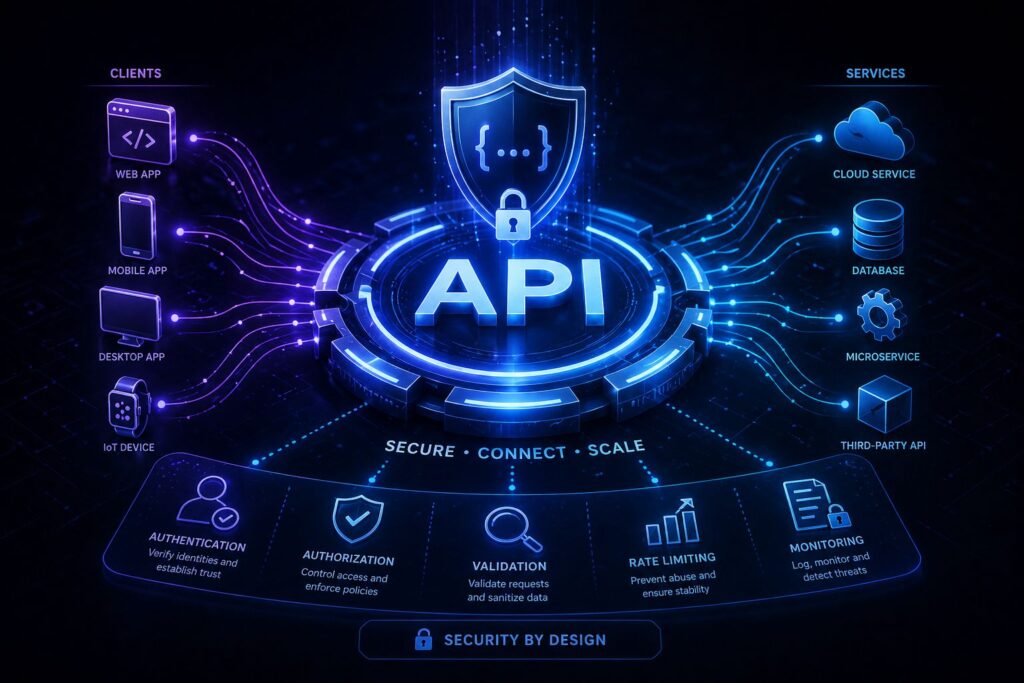
The adoption of cloud computing fundamentally transformed enterprise architecture. Organizations now deploy workloads across Infrastructure as a Service, Platform as a Service, and Software as a Service environments, often spanning multiple cloud providers and geographic regions. Applications are increasingly built using microservices architectures, where loosely coupled components communicate through APIs.
In this model, APIs serve as the primary interface for integration, enabling real time communication between applications, cloud services, and external ecosystems. Mobile applications, partner platforms, and third party vendors rely heavily on APIs to access backend services and exchange data dynamically.
This shift from internal integration to externally exposed interfaces significantly expands the attack surface. APIs are no longer confined within enterprise boundaries. Instead, they act as direct entry points into critical systems, often handling sensitive data and business transactions.
Industries such as financial services, healthcare, telecommunications, and e commerce have embraced API driven architectures to deliver digital services at scale. As organizations accelerate cloud adoption, the number of APIs in production continues to grow rapidly, often without corresponding increases in security maturity.
API Fundamentals: Types and Security Considerations
An API is a structured interface that defines how applications communicate, exchange data, and invoke services. It specifies request methods, data formats, and response mechanisms.
- REST APIs have become the dominant model for modern integrations due to their simplicity, scalability, and alignment with web standards. They use standard HTTP methods and are well suited for cloud native and microservices environments.
- SOAP APIs, while more rigid, provide built in security standards and are often used in regulated industries where strict compliance requirements exist.
- GraphQL APIs allow clients to request only the data they need, improving efficiency but introducing new security considerations related to query complexity and data exposure.
It is important to recognize that security is not determined by API type alone. A well implemented REST API with strong authentication, encryption, and access controls can be as secure as or more secure than a SOAP based implementation. Security depends on how effectively controls are applied across the API lifecycle.
Organizational Maturity and API Security Gaps
Despite the critical role APIs play in modern architectures, many organizations struggle with API security maturity. A significant percentage of enterprises operate without a formal API security strategy, leaving gaps in governance, visibility, and risk management.
One of the most common challenges is maintaining an accurate inventory of APIs. Shadow APIs that are undocumented and zombie APIs that are no longer actively managed create blind spots that attackers can exploit. Limited monitoring and insufficient logging further reduce the ability to detect anomalies and respond to incidents.
Resource constraints, including shortages of skilled personnel and limited budgets, often hinder the implementation of robust API security programs. As a result, APIs frequently become the weakest link in an organization’s security posture.
Key Security Risks in API Integrations
APIs interact directly with backend systems, business logic, and sensitive data, making them attractive targets for cyber adversaries. Common risks include unauthorized access due to weak authentication or authorization mechanisms, excessive data exposure where APIs return more information than necessary, and broken object level authorization that allows attackers to manipulate identifiers and access unauthorized data.
Automated attacks such as credential stuffing, scraping, and denial of service are increasingly targeting APIs. These attacks exploit the predictable and structured nature of API endpoints.
Shadow and unmanaged APIs further increase risk by operating outside of standard security controls. These vulnerabilities are widely documented in industry frameworks and highlight the need for comprehensive API security strategies.
Secure Protocols for API Communication
- Securing API communication begins with the use of standardized and robust protocols. HTTPS with TLS encryption ensures confidentiality and integrity of data in transit. Mutual TLS strengthens this model by enabling both client and server authentication through digital certificates.
- OAuth 2.0 provides a secure authorization framework that enables controlled access to APIs using tokens rather than credentials. OpenID Connect extends this capability by providing identity authentication.
- JSON Web Tokens are widely used for secure token based authentication and authorization, enabling stateless and scalable security models. These protocols form the foundation of secure API interactions in modern environments.
Security Controls for Protecting APIs
- A defense in depth approach is essential for securing APIs. API gateways act as centralized control points, enforcing authentication, authorization, rate limiting, and traffic management. They provide visibility into API usage and enable consistent policy enforcement.
- Web Application Firewalls protect APIs by inspecting traffic for malicious patterns and blocking common attacks such as injection and malformed requests. Modern WAF solutions include API specific protections such as schema validation and behavioral analysis.
- Distributed Denial of Service protection mechanisms are critical for ensuring availability. APIs exposed to the internet are vulnerable to traffic floods that can disrupt services. Cloud based DDoS protection solutions detect and mitigate these attacks before they impact operations.
- Network level controls such as IP allow listing, domain restrictions, and micro segmentation limit access to trusted entities. These controls reduce the exposure of APIs and prevent unauthorized access.
- Data minimization and the principle of least privilege ensure that APIs expose only the necessary data and functionality required for specific use cases. This approach reduces the impact of potential breaches.
Governance, Testing, and Lifecycle Management
API security must be integrated into the entire development and operational lifecycle. Secure design practices should be applied during the initial stages of development, followed by rigorous testing including vulnerability assessments and penetration testing.
Continuous monitoring and anomaly detection enable organizations to identify and respond to threats in real time. Maintaining version control and properly deprecating outdated APIs reduces the risk of unmanaged interfaces.
A comprehensive inventory of all APIs is critical for maintaining visibility and control. Organizations must also invest in training developers and operational teams to follow secure coding practices and adhere to established standards.
Framework Alignment
Several industry frameworks provide guidance for securing APIs.
NIST SP 800-204 and SP 800-228 together emphasize securing API-driven, cloud-native and microservices architectures through a defense-in-depth approach, including API gateways, strong service-to-service authentication, and encrypted communication.
The OWASP API Security Top 10 identifies common vulnerabilities and serves as a practical reference for risk mitigation.
Essential Guardrails and Best Practices
- To strengthen API security maturity, organizations should implement continuous discovery mechanisms to identify and catalog all APIs. Strong authentication and authorization controls, including multi factor authentication and token based access, are critical.
- Data validation and strict input controls prevent injection attacks, while rate limiting and throttling protect against abuse and automated threats. Centralized management through API gateways ensures consistent enforcement of security policies.
- Regular testing, continuous monitoring, and integration of security into the development lifecycle are essential for maintaining resilience. These practices help organizations proactively identify vulnerabilities and reduce risk.
Conclusion: Securing the Digital Integration Layer
API security depends less on the protocol and more on the implementation, strong authentication, encryption, and access control define a secure API, not just its type.
APIs have become the backbone of modern digital ecosystems, enabling organizations to deliver services with unprecedented speed and efficiency. However, this connectivity introduces significant security challenges that cannot be ignored. Unlike legacy integration models, modern APIs expose critical systems directly to external environments. Without proper security controls, they can become entry points for cyber attacks, leading to data breaches, financial loss, and operational disruption.
Organizations must adopt a comprehensive and layered approach to API security, combining secure protocols, strong identity controls, network protection, and continuous monitoring. Equally important is the integration of security into governance frameworks, development practices, and organizational culture.
As enterprises continue to embrace cloud technologies and digital transformation, securing APIs will remain a critical priority. Addressing the hidden risks associated with API integrations is essential for building resilient, secure, and future ready digital infrastructures.
References
- OWASP Foundation, OWASP API Security Top 10, 2023.
- Cloud Security Alliance, Top Threats to Cloud Computing: Insecure Interfaces and APIs, 2022.
- National Institute of Standards and Technology, NIST Special Publication 800-204: Security Strategies for Microservices-based Application Systems, Gaithersburg, MD, USA, 2019.
- National Institute of Standards and Technology, NIST Special Publication 800-228 Revision 1: Guidelines for API Protection for Cloud-Native Systems, Gaithersburg, MD, USA, 2023.
- 42Cruch, API Security Insights and Resources, 2024.
Enjoyed this article?
If TechLatest has helped you, consider supporting us with a one-time tip on Ko-fi. Every contribution keeps our work free and independent.
Support on Ko-fiDirectly in Your Inbox