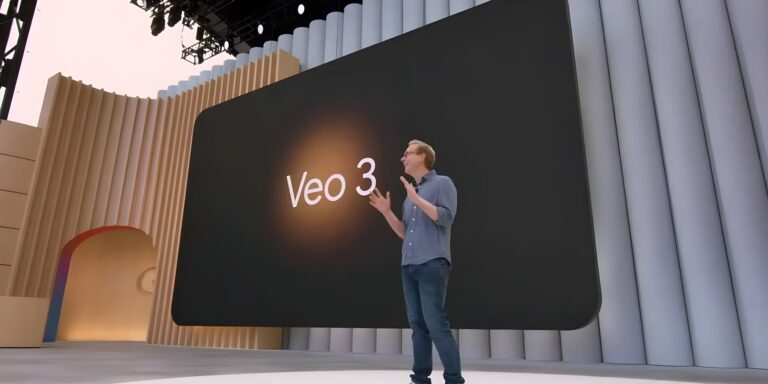
The development of video advertisements using Google Veo 3 can become a breakthrough in your marketing campaigns, and with its assistance you are capable of making quality and engaging content in a shorter period of time and with limited expenses.
Google Veo 3 uses the power of artificial intelligence to make video creation as easy as possible, allowing businesses and marketers to create an advertisement that would captivate their audience.
Don’t want to miss the best from TechLatest?
Set us as a preferred source in Google Search
and make sure you never miss our latest.
This in-depth guide will take you on a trip through the process of realizing the full potential of Google Veo 3 in creating video ads.
Read: OpenAI’s ChatGPT Health Changes the Wellness Game
Step 1: Define Your Campaign Goals
It is important that you first establish your campaign goals before you begin to make your video ad. What do you want to accomplish with your advertisement? The general tone, style, and message of the video will be directed by your objectives. Popular video advertisement goals are
Brand Awareness: You might have a new audience or have to reach a wider audience with your brand.
- Lead Generation: In case you want to generate leads, your video must have the call to action so that viewers could sign up or become involved.
- Conversions: When you are marketing a certain product, you should pay attention to the creation of a persuasive video proving its advantage and moving to sales.
The outlined objectives will assist you in making the video script, visuals, and general approach unique to your needs so that your ad could produce the necessary effect.
Step 2: Leverage AI Scriptwriting
Among the remarkable aspects of Google Veo 3, there is the ability of the application to write scripts with the help of AI. Google Veo 3 has no need of writing scripts at all. Rather, the tool will create stories that fulfill your campaign objectives and appeal to your target audience based on AI algorithms.
All you need to make an AI script is to put in some basic data regarding your campaign, including your intentions, the demographic you will work with, and the most important messages of your campaign.
Google Veo 3 will produce a script containing persuasive language, a compelling narration style, and a call to action. The AI scriptwriter is also able to adjust the message tone to suit the voice of your brand, whether it’s a more relaxed and casual message or a more formal and corporate sound.

Step 3: Design Your Video
After you have your script, designing your video is the next thing you have to do. Google Veo 3 has various customization features that will make your ad in line with your brand identity. You have the ability to tailor the following:
Text: This is the addition of text to highlight important messages, calls to action, or product characteristics.
- Graphics and Animations: Make your video more attractive with attractive animations and graphics to explain the most important points.
- Stock Footage & Images: Google Veo 3 also offers a library of stock footage and images, from which you can easily get visual materials that go with your script.
Also, you are free to change the speed of the video and customize the aesthetic style to your brand. Google Veo 3 is flexible in creating the ideal video that you can use for your marketing needs regardless of whether you need a sleek and more professional appearance or something more playful.
Step 4: Integrate High-Quality Audio
To develop powerful video adverts, one needs a crisp audio experience. The Google Veo 3 makes it easier by incorporating professional-level audio features into the system. You can easily incorporate:
Voiceovers: Include professional voiceovers that match your writing. Google Veo 3 also gives you the chance to change the pace and tone of the voiceover to suit the emotional tone in the advertisement.
- Background Music: Select the background music out of a library of royalty-free background music to add a mood to your video. The music must conform to the images and emphasize what your ad is saying.
- Sound Effects: This is to add sound effects to indicate important points in your video, like product demonstrations or calls to action.
You can make sure that your video ad is as polished and professional as it appears because Google Veo 3 offers high-quality audio tools.
Step 5: A/B Test Video Variations
The ability to have several variations of the same video is one of the strongest capabilities of Google Veo 3. The essential component of video ad optimization is the A/B testing that helps to make the video ads as effective as they can get. You can test many video elements (with Google Veo 3), including
Video Length: Short, snackable videos vs. longer, more in-depth content.
- Headlines: Test out various headlines or opening sentences and phrases to determine the one that appeals to the readers the most.
- Calls to Action: Experiment with various calls to action to find out which one is the most effective in generating conversions.
You can test and find the best-performing video and adjust your ad strategy to achieve the best outcomes.
Step 6: Retargeting Ads
Google Veo 3 also allows easy retargeting of those viewers that have already engaged with your advertisements.
Through advanced analytics, Veo 3 would analyze user behavior such that you can know the viewer who has consumed your content and their position in the customer journey.
This data will enable you to make retargeting advertisements that help build leads and invoke additional action.
As an illustration, should a person view your product demonstration and fail to buy it, then you may retarget them with an ad where you are giving them a discount or a customer review so that they will move closer to buying the product.
Step 7: Publish and Analyze Performance
After completing your video ad, it is time to distribute it in all the places that you have selected. Google Veo 3 can be connected to the most famous social media, such as Facebook, Instagram, and YouTube, so that there is no problem with sharing your video with your target audience.
Whereas after your ad is released, the in-built analytics tools in Google Veo 3 enable you to monitor its performance in real time. The most important indicators that should be tracked are
- Views: What is the number of people who watched your video?
- Engagement: How many viewers liked, shared, or commented on your ad?
- Conversions: What was the number of viewers that did the intended action (e.g., purchase or subscription)?
These lessons can assist you in improving your video advertisements and modifying your marketing plan in the best way possible.
Conclusion
The development of quality and AI-driven video ads using the Google Veo 3 does not need to be a complex procedure. These seven steps will help you create professional, engaging content that will produce results by concentrating on the definition of your campaign goals, as well as its performance analysis.
In the case of businesses oriented towards fast testing and experimentation, you can use tools such as Kling AI to supplement your work, which can quickly produce cheap video variations, which can be optimized in terms of their performance on various social media platforms.
Enjoyed this article?
If TechLatest has helped you, consider supporting us with a one-time tip on Ko-fi. Every contribution keeps our work free and independent.
Support on Ko-fiDirectly in Your Inbox