AI is not a robot marching into your office. It is more like electricity quietly rewiring how software gets built.
That shift feels personal. For many engineers, code represents ability, knowledge, and experience. When AI models start drafting functions or generating tests, it can feel like part of the craft is being automated.
Don’t want to miss the best from TechLatest?
Set us as a preferred source in Google Search
and make sure you never miss our latest.
Today, in engineering teams, you can hear the same mix of curiosity and caution. Numerous developers are also testing AI, even though they are still not convinced of its reliability or long-term effects. That skepticism is healthy. Production systems require accuracy, and a rapid solution will not be useful if it poses a latent danger.
To put things into perspective, we can learn from history how similar scenarios have played out. The Industrial Revolution replaced repetitive labor but created new industries. The internet’s automated distribution and communication have expanded the need for software engineers. AI follows a similar pattern, only faster.
The real question is simple. What does AI automate, and what remains distinctly human?
Every Technological Leap Redefines Work Rather Than Eliminating It
Technological shifts rarely erase engineering roles. What they usually do is raise the level of abstraction.
Electricity changed factories. It did not eliminate craftsmanship. The internet automated information exchange. It created new domains in backend systems, cybersecurity, cloud computing, and distributed architectures.
Today, teams reassess workflows in light of AI-assisted development. They look closely at where time accumulates and where repetition dominates. AI models enter that environment as infrastructure. They compress routine steps inside existing pipelines, but they do not replace architectural reasoning.
That distinction helps teams focus on practical trade-offs instead of fear.
What AI Is Actually Automating in Software Development
The strongest reactions to AI often assume it replaces entire roles. In practice, automation targets specific tasks.
Repetitive Development Tasks
AI models handle repetition well. They can generate boilerplate scaffolding, draft unit tests, suggest straightforward refactors, fix formatting issues, summarize pull requests, and flag recurring bug patterns.
Repetition maps cleanly to prediction. Architectural trade-offs simply do not.
The industry conversation is growing around abandoning simple autocomplete in favor of workflow software engineering optimization, with fewer friction outliers and more friction-free pipelines.
When training a system takes less time than executing the task manually, engineers can improve performance and define the data. Automation is more inclined to repetition than creativity.
Embedded ML Models in IDE Workflows
Modern ML models integrate directly into development environments. They enable context-aware suggestions based on surrounding code. They augment static analysis. They allow semantic search across repositories using embeddings rather than exact keyword matches.
A developer can now query a large codebase in natural language and quickly pull up the components that matter. That retrieval reduces context-switching and speeds up onboarding.
These improvements depend on integration quality. Embedded directly into engineering workflows, AI models reduce measurable friction. Used separately, they mostly create novelty.
Inside Modern AI-Driven Engineering Pipelines
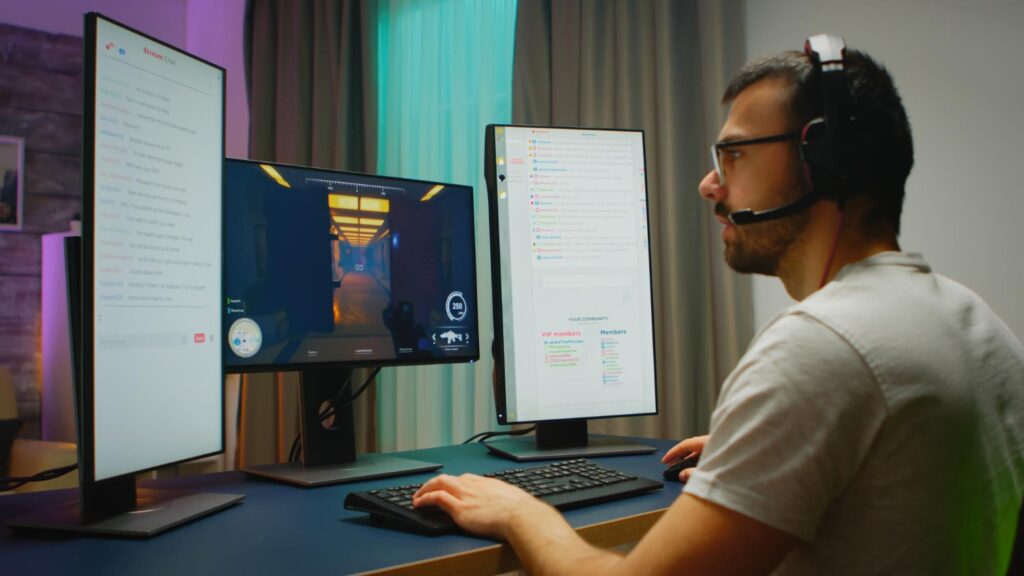
The most meaningful changes are happening beneath the surface, inside the infrastructure that supports daily development work.
ML Models in Production Workflows
ML models already assist in structured engineering tasks. Classification models are used to triage logs, anomaly detectors signal unusual behavior, regression models predict usage patterns, and embedding models assist semantic code search.
When AI code assistants integrate into version control and continuous integration workflows, productivity still depends on disciplined review. AI accelerates drafting, but engineers validate logic and side effects.
Latency shapes usefulness. Inference delays disrupt flow, and context windows limit how much code models evaluate at once. Teams with clear data foundations and structured pipelines integrate AI more effectively because context retrieval becomes predictable. AI works best inside well-defined architecture.
How Retrieval-Augmented Generation (RAG) Improves Code Context
Large language models generate tokens using training data, which allows them to take plausible and erroneous grounds.
To overcome that shortcoming, RAG plans to index project documentation and source code, convert them into embeddings, then retrieve pertinent chunks and, with prompts, generate results.
That retrieval step anchors responses to the repository state. For example, if a developer queries an internal logging utility, RAG can pull the correct method signature before generation, reducing incorrect parameters and deprecated references.Technical overviews describe this structured pipeline as indexing, retrieval, and generation. In practice, RAG reduces hallucinated APIs and improves alignment with internal coding standards.
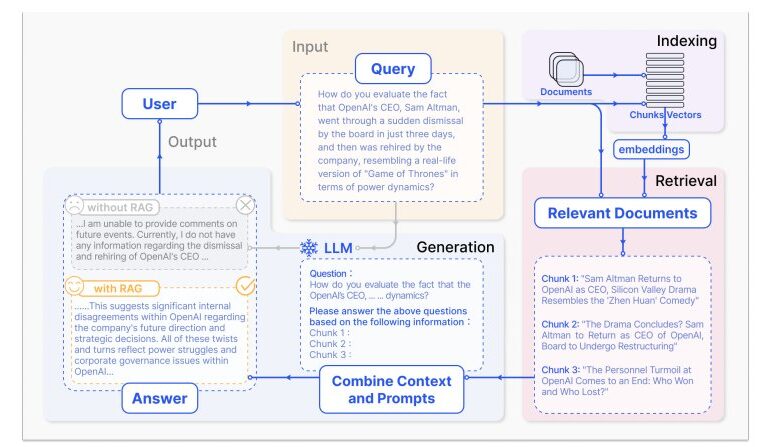
The diagram shows how documents become embeddings, how retrieval surfaces relevant chunks, and how generation produces grounded output.
Model Context Protocol (MCP) Servers and Orchestrated AI Systems
RAG handles retrieval. Orchestration coordinates everything else.
MCP servers provide standardized interfaces between AI models and external tools. They manage context injection, route queries to the right endpoints, invoke tools, and control token budgets.
MCP server orchestration concepts show how AI systems behave more like a distributed infrastructure than a standalone chat tool. A single request can trigger retrieval, function execution, validation, and structured output formatting.
The architecture looks very similar to classic distributed systems design. It requires observability, latency management, and careful dependency handling.
AI becomes part of the system architecture. It no longer sits outside it as a separate assistant.
What AI Still Struggles to Automate
Automation consistently targets repetition before creativity.
AI models still struggle with system-level architectural trade-offs. They cannot negotiate ambiguous stakeholder requirements. They do not assume accountability for ethical decisions. They do not lead cross-team initiatives.
Complex engineering often involves constraint negotiation. Memory limits. Compliance requirements. Security boundaries. Performance budgets. Those dimensions require contextual awareness and long-term thinking.
AI accelerates execution. Engineers still carry responsibility for direction. Recognizing that boundary clarifies where value shifts rather than disappears.
Productivity Gains Without the Hype
Productivity gains exist, but they vary by task type.
AI speeds the document release, rewriting, scaffolding tests, and initial prototyping. In routine-based tasks where repeatability prevails, teams record quantifiable time savings in task accomplishment.
Comparison of task completion reveals that AI help increases the likelihood of completing medium and high-complexity work within the time range, whereas simpler tasks show less significant improvement.
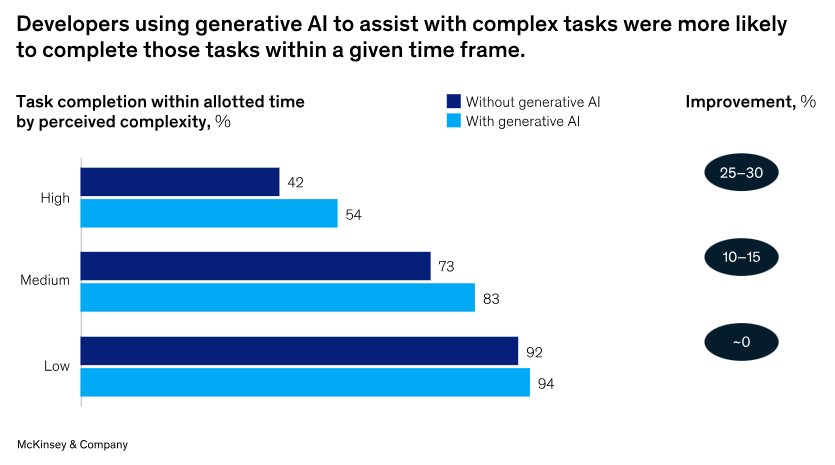
The pattern aligns with experience. Structured tasks benefit more than open-ended system design.
The practical takeaway is simple:
- Delegate repetitive work to AI models.
- Validate outputs carefully.
- Reinvest saved time into architectural clarity and long-term maintainability.
Teams that treat AI as a collaborator rather than an authority integrate it more successfully.
Technology Disrupts Tasks, Not Engineers
AI is not the end of engineering. It is the next abstraction layer, moving faster than previous ones but still following a familiar trajectory.
Anxiety is understandable when tools start performing tasks once considered core to the role. History shows that technology disrupts tasks more than it destroys human value, and roles evolve as specializations emerge.
Data engineering, cloud architecture, and platform engineering expanded because infrastructure changed.
The shift is architectural, not theatrical.
The Developer Advantage in an AI-Augmented Era
The engineers who thrive will not compete with AI. They will orchestrate it. Human strengths remain central:
- Architectural reasoning
- Strategic system design
- Contextual interpretation
- Leadership and negotiation
- Ethical judgment
- Creative problem solving under ambiguity
AI shifts the center of gravity upward. Repetition decreases. Design importance increases.
For developers concerned about job security, practical steps help:
- Learn how ML models integrate into pipelines.
- Understand when to apply RAG instead of generic prompting.
- Explore how MCP servers coordinate AI services across environments.
- Maintain strong fundamentals in system design and data architecture.
Experiment deliberately. Integrate AI models into controlled workflows, measure impact, and retain architectural ownership.
Software engineering has never remained static. Each abstraction layer created new opportunities for those willing to adapt.
AI is another shift, faster than previous ones, but still grounded in a familiar pattern of technological change.
References:
- Bain & Company. (2024). Beyond code generation: More efficient software development. Bain & Company. https://www.bain.com/insights/beyond-code-generation-more-efficient-software-development-tech-report-2024/
- Gao, Y., Xiong, Y., Gao, X., Jia, K., Pan, J., Bi, Y., Dai, Y., Sun, J., Wang, M. and Wang, H. (2024). Retrieval-augmented generation for large language models: A survey. arXiv. https://arxiv.org/abs/2312.10997
- McKinsey & Company. (2023). Unleashing developer productivity with generative AI. McKinsey & Company. https://www.mckinsey.com/capabilities/tech-and-ai/our-insights/unleashing-developer-productivity-with-generative-ai
- Model Context Protocol. (n.d.). Server concepts. https://modelcontextprotocol.io/docs/learn/server-concepts
- Stack Overflow. (2024). 2024 AI survey [Dataset]. Stack Overflow. https://survey.stackoverflow.co/2024/ai
- Weisz, J.D., Kumar, S., Muller, M., Browne, K.-E., Goldberg, A., Heintze, E. and Bajpai, S. (2025). Examining the use and impact of an AI code assistant on developer productivity and experience in the enterprise. arXiv. https://arxiv.org/abs/2412.06603
Enjoyed this article?
If TechLatest has helped you, consider supporting us with a one-time tip on Ko-fi. Every contribution keeps our work free and independent.
Support on Ko-fiDirectly in Your Inbox